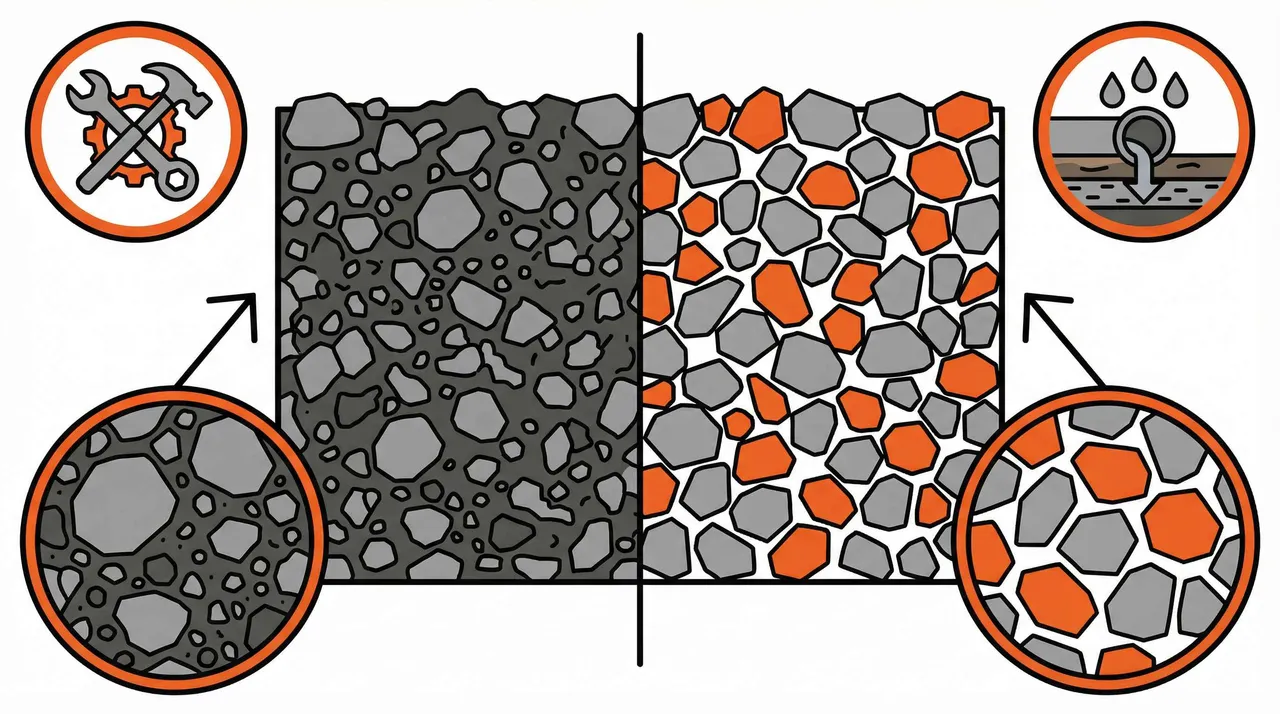
Here is the short answer. If water needs to move through the stone — French drains, foundation drains, behind retaining walls — you want #57 stone. If you need a hard, stable surface that carries weight — driveway, shed pad, paver base — you want crusher run. And if you are building a driveway on soft or wet ground, the real answer is both: a drainage layer below, crusher run compacted on top.
These are the two most-ordered products at almost every quarry in America, and they are near-opposites in behavior. One is washed and stays loose forever; the other is dusty on purpose and turns nearly solid under a plate compactor.
Pick #57 for anything that needs to drain — French drains, wall backfill, pipe bedding. Pick crusher run for anything that needs to bear weight — driveways, paver bases, shed pads. On soft or wet ground, use both in layers.
| Factor | #57 Stone | Crusher Run |
|---|---|---|
| What it is | Washed, clean stone, 1/2–1 inch | Stone up to ~3/4–1 inch mixed with fines down to dust |
| Gradation type | Open-graded (36–42% voids) | Dense-graded |
| Drainage | Excellent — water flows straight through | Poor — compacts nearly watertight, sheds water instead |
| Compaction | Never densifies; stones rearrange but stay loose | Compacts into a hard, near-solid layer |
| Surface feel | Loose, crunchy, can shift underfoot | Firm, almost pavement-like when compacted |
| Typical cost | $25–$45 per ton | $25–$45 per ton, often at the lower end |
| Best for | Drains, pipe bedding, concrete aggregate, top dressing | Driveway base, paver base, shed pads, road repair |
Drainage: #57 Wins, and It Is Not Close
#57 is washed at the quarry, so there are no fines to plug the gaps between stones. Those gaps — 36–42% of the volume — act as open channels, which is why every French drain, foundation perimeter drain, and retaining-wall backfill spec calls for clean stone. Water enters, drops, and moves on.
Crusher run does the opposite. Its fines fill every void, and once compacted it behaves more like weak pavement than like gravel: water runs off the top rather than soaking through. That is a feature on a crowned driveway and a fatal flaw in a drain. Put crusher run in a French drain and you have built an underground dam.
Compaction and Stability: Crusher Run Wins
The same fines that ruin drainage are what make crusher run structural. Under a plate compactor or a few weeks of traffic, the dust and chips lock the larger stones together into a dense, interlocked mass that spreads loads and resists rutting. This is why crusher run — and its regional twins #411, 2A modified, and DGA — is the default base under driveways, pavers, and sheds. (Full naming breakdown in What Is Crusher Run?)
#57 never does this. Clean stone can be seated and tightened, but it never densifies into a solid layer; the rounded-over voids remain and the stones keep a little freedom to move. Park a car on 4 inches of loose #57 over soft soil and you will find wheel ruts by the weekend.
Surface and Everyday Use
As a finished surface, crusher run packs down firm enough to roll a wheelbarrow, stroller, or motorcycle across without sinking. It does produce some dust in dry weather and can go soft in a prolonged soak if poorly graded.
#57 as a top layer stays permanently loose — noisy, crunchy, and self-cleaning. Rain passes through instead of puddling, and it never gets muddy. The tradeoff is migration: tires slowly push it around, so it needs occasional raking and works best confined by edging or laid over a compacted base.
Cost and Ordering
Price rarely decides this one. Both sit in the $25–$45 per ton range, with crusher run frequently a few dollars cheaper because it skips the washing step. Crushed stone runs about 1.5 tons per cubic yard, so a 12×50-foot driveway at 4 inches deep needs roughly 7.5 cubic yards — call it 11 tons. Run your own numbers with the #57 stone calculator or the crusher run calculator, and remember compaction: dense-graded material loses 10–15% of its loose depth under the plate, so order accordingly.
The Both-Layers Driveway Answer
On well-drained ground, a driveway can be crusher run top to bottom: two compacted 3-inch lifts and done. But on wet, springy, or clay-heavy ground, the pro build uses both products in layers:
- Layer 1: geotextile fabric over the subgrade, then 3–4 inches of clean stone (#57, or #3 on truly soft ground) as a drainage and bridging layer.
- Layer 2: a second run of fabric so fines cannot wash down and clog the clean stone.
- Layer 3: 3–4 inches of crusher run, compacted in lifts, crowned so water sheds to the edges.
Water that gets under the driveway drains away through the open layer instead of pumping up through the base as mud. Size the whole stack in one pass with the gravel driveway calculator.
Which Should You Choose?
- French drain, curtain drain, drain field: #57, always. Never crusher run.
- Behind a retaining wall: #57 — walls fail from trapped water, not from soil.
- Driveway, parking pad, shed base on dry ground: crusher run, compacted in lifts.
- Driveway over wet or soft ground: both — clean stone below, fabric, crusher run on top.
- Paver patio base: crusher run (traditional) or open-graded #57/#8 (permeable systems) — pick one system and follow it throughout.
- Decorative ground cover: #57 — it stays clean and never turns to dust.
Cost Comparison in Detail
On the price tag alone, these two are close enough that cost rarely breaks the tie — but the total project cost diverges once you factor in what each material needs to actually do its job.
| Cost Factor | #57 Stone | Crusher Run |
|---|---|---|
| Material, per ton | $25–$45 | $25–$45 (often $2–$5 less, no washing step) |
| Delivery (local, per load) | $50–$150 flat, cheaper per ton on full loads | $50–$150 flat, same structure |
| Fabric needed underneath | Often yes, to stop fines migrating up into it | Sometimes, on soft subgrade |
| Compaction equipment | Not required — it never densifies | Plate compactor rental, $75–$150/day if hired out |
| Extra material for top-ups | Rare — stays put once seated | Every 2–4 years as surface wears |
The real cost difference shows up in labor and equipment, not the stone itself. Crusher run needs a compactor pass — rented or contractor-supplied — to deliver its structural benefit; skip that step and you have simply bought expensive dirt that behaves like loose gravel. #57 needs no compaction equipment at all, but it more often needs geotextile fabric both above and below it to keep fines from migrating in and clogging the void space that makes it work as a drain. Net-net: a straightforward crusher run driveway base and a straightforward #57 drainage layer end up within a few percent of each other in total installed cost for the same tonnage.
You Already Have One — Do You Need the Other?
A common real-world question: a pile of one material is already on-site, or already down, and a new problem shows up that seems to call for the other. Here is how to handle the common cases without ordering (or hauling away) more than necessary.
- You have crusher run and need a French drain. Do not use it. Buy #57 separately for the drain trench — even a partial mix of crusher run fines into the drain rock will start clogging it within a season. The two materials should never touch inside a drainage system.
- You have #57 and need a driveway base. You can use it, but expect it to feel loose and rutted under vehicle weight unless you cap it with 3–4 inches of crusher run or a similar dense-graded material. #57 alone as a driveway surface is a maintenance headache, not a structural failure — it will just never firm up the way crusher run does.
- You over-ordered crusher run for a driveway and have leftover material. Good news — it is genuinely useful elsewhere: shed pads, filling low spots that need to stay firm, or a base layer under pavers. It just cannot go anywhere drainage is the goal.
- You over-ordered #57 for a drain. Leftover clean stone works well as decorative ground cover, a top dressing over crusher run, or bedding for drainage pipe elsewhere on the property — it holds its value better than leftover crusher run because it never needs to be “used up” before it degrades.
The one mistake to avoid in either direction is trying to make one material do the other’s job by adjusting technique — no amount of compaction will make clean #57 drain-proof-turned-solid, and no amount of washing will turn crusher run’s fines-in-place back into an open-graded drain rock. When the wrong material is already on-site, the fix is almost always to add the missing layer, not to force the one you have to behave differently.
Bottom Line
Ask one question: do I need water to pass through this stone, or loads to pass over it? Through means #57. Over means crusher run. Both means layer them with fabric in between. For a deeper look at the full range of sizes these two come from, see the complete crushed stone size chart.